
M. Uhrich and Associates - Paris & Boston
Developing competencies in people and organizations.
PAGES
RECENT POSTS

TWITTER UPDATES
July 15, 2010
Being International (previous page)
About the book: “Glocal” Working – Living and working across the world with cultural intelligence
First some background about the book.
The book “Glocal” Working is a collection of papers and is divided into two sections
Paradigms and Models
Experiences and Best practices
with contributions from 25 authors on the subject.
For more information:"Glocal" workingor FrancoAngeli.
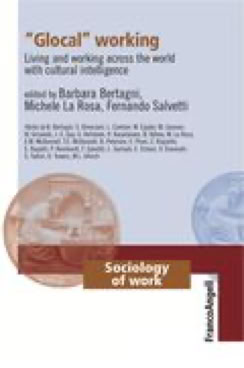
With permission from the editor, here is an overview of its scope and contents.
INTRODUCTION
“Glocal” working: a short introduction©
Barbara Bertagni, Michele La Rosa and Fernando Salvetti
To live and work in our “glocal” (global & local) world, we have to be innovative as “outsiders” able to see the same things in many different ways. Being an “outsider” is both a challenge and a competitive advantage. If we see and think differently about a business need, a problem, or a market’s niche, we have a good chance of coming up with an out-of-the-box approach - one that’s original, unique and competitive. So we need some cross-cultural intelligence.
Cultural intelligence is the ability to bridge and benefit from the cultural complexity of people with different nationalities, professional backgrounds and fields, personalities and organizational cultures. Cultural intelligence combines the emotional, cognitive and practical dimensions of cross-cultural encounters and ensures more effective and fulfilling cross-cultural collaboration. Cultural intelligence means being skilled and flexible about understanding a culture, learning more about it from ongoing interactions with it and gradually reshaping your thinking to be more sympathetic to the culture and your behavior to be more skilled and appropriate when interacting with others from the culture.
Today cultural intelligence is a big challenge; the cognitive paradigms, the relational schemas and the value systems among cultures have been shown to vary significantly, not only among different countries, but also among professional people working in the same corporation. For instance, people from different cultural backgrounds are likely to have different attitudes towards hierarchy, ambiguity, achievement orientation, time and working with others.
Do we know how to understand the implicit, basic assumptions that guide people’s behavior in different areas of our world? Do we know how to interpret the explicit norms and values that guide a foreign society? Starting with these questions, or with similar ones, we may draw up a scheme useful in understanding a new business context and, at the same time, develop our own cognitive maps - intellectual flexibility, creativity, ability to innovate – in the “glocal” world. We must learn to be like Proteus – flexible enough to adapt with knowledge and sensitivity to each new cultural situation that we face.
We are all becoming “glocal” people and everyone can learn to be more culturally intelligent.
CONTENTS
“Glocal” working: a short introduction,Barbara Bertagni, Michele La Rosa and Fernando Salvetti
First Part – Paradigms and Models
Think locally, act globally: cultural constraints in personnel management, Geert Hofstede
Three cultures of management: the key to organizational learning, Edgar Schein
The cultural metaphoric method: description, analysis and critique, Martin Gannon
Cultural intelligence: a concept for bridging and benefiting from cultural differences, Elisabeth Plum
Cultural codes: birth of a notion, Clotaire Rapaille
What is cultural intelligence?, Brooks Peterson
Anthropology and epistemology for “glocal” managers: understanding the worlds in which we live and work,Barbara Bertagni and Fernando Salvetti
Second Part – Experiences and Best practices
On being international: reflections on living an international life: with observations and suggestions, Mark Louis Uhrich
France - US comparisons: some comparisons between France and the United States, Mark Louis Uhrich
Skills for global business: cultural intelligence & business development, Fernando Salvetti
“Glocalizing” visual communication in organizations: when and how to adapt visual communication to local standards, Sabrina Bresciani andMartin Eppler
Generation Y and “glocal” working, Lorenzo Cantoni, Emanuele Rapetti and Stefano Tadini
Drumstorming music: a percussion and training experience based method, Vittorio Simonelli
What instruments and practices for the management of a multicultural staff?,Helena Karjalainen
Cross-cultural coaching, Barbara Köhne
Be innovative and learn how to learn! Cultural intelligence to a better learning, Fernando Salvetti
Knowledge sharing + Networking = Product’s Innovation (x 2… x 3… ∞),Fernando Salvetti
What is global and what is local? A theoretical discussion around globalization, Jean-Sébastien Guy
Global / Local services, Fernando Salvetti
Managing in Asia: conflict, incomprehension, or successful relations? The difficulties encountered by Western expatriate managers in Asia, Pascale Reinhardt
Living “glocally” with literacy success in the US Midwest, Loukia Sarroub
Glamour and honor: going online and reading in West African culture, Wendy Griswold, Erin Metz McDonnell and Terence Emmett McDonnell
Wal-Mart: a glocalized company, David Towers
July 15, 2010 in Being International|Permalink|Comments (0)
Prologue
As many of you may know, I live an international life — two countries, a lot of travel, and doing business over large portions of the globe. Other people and places was something that I found interesting. In my professional work, I found sought out opportunities for international involvement. This gave me the opportunity for travel and international business - in many countries. This lead to international studies in the United States and in France. In 1992, I moved to France where I now live and work.
While at Insead on an executive program, I was first exposed to the cross-cultural research of Geert Hofstede. That lead to my studying further to understand the cross-cultural environment and what I had experienced internationally. I began to teach and speak on the subject – especially as related to the business environment.
Recently, I was invited to contribute to a book that was in preparation. The muses worked slowly but the article did, finally, come together and the reviewers found that it added value. The book is titled “Glocal” working: Living and working across the world with cultural intelligence and my contribution is the paper “On Being International” plus a overview comparison between France and the United States.
I delayed starting this series pending publication of the book so as to not preempt it. Now that it is published, I can start to write about what I have learned about living and doing business internationally.
Certainly, many of you have had similar experience – even greater. My hope in sharing my experience is that you find it to be interesting and of value. Maybe you will agree with me. Possibly your view will be different from mine. Either way, I will welcome your feedback.
Maisons-Laffitte, France, 15 July 2010
Next:about the book
July 15, 2010 in Being International|Permalink|Comments (0)
January 16, 2007
Coming soon — “Uhrich on Management” — a periodic column concerning the management of people and organizations. Topics will include:
• Managing people to achieve motivation and performance
• Managing the organization for results and efficiency
• Resolving difficulties in people and organizations
• Driving and managing change
Coming soon. Watch for it.
January 16, 2007 in Uhrich on Management|Permalink|Comments (0)|TrackBack (0)